Scaling vs. Growing Your Business (EP#59)
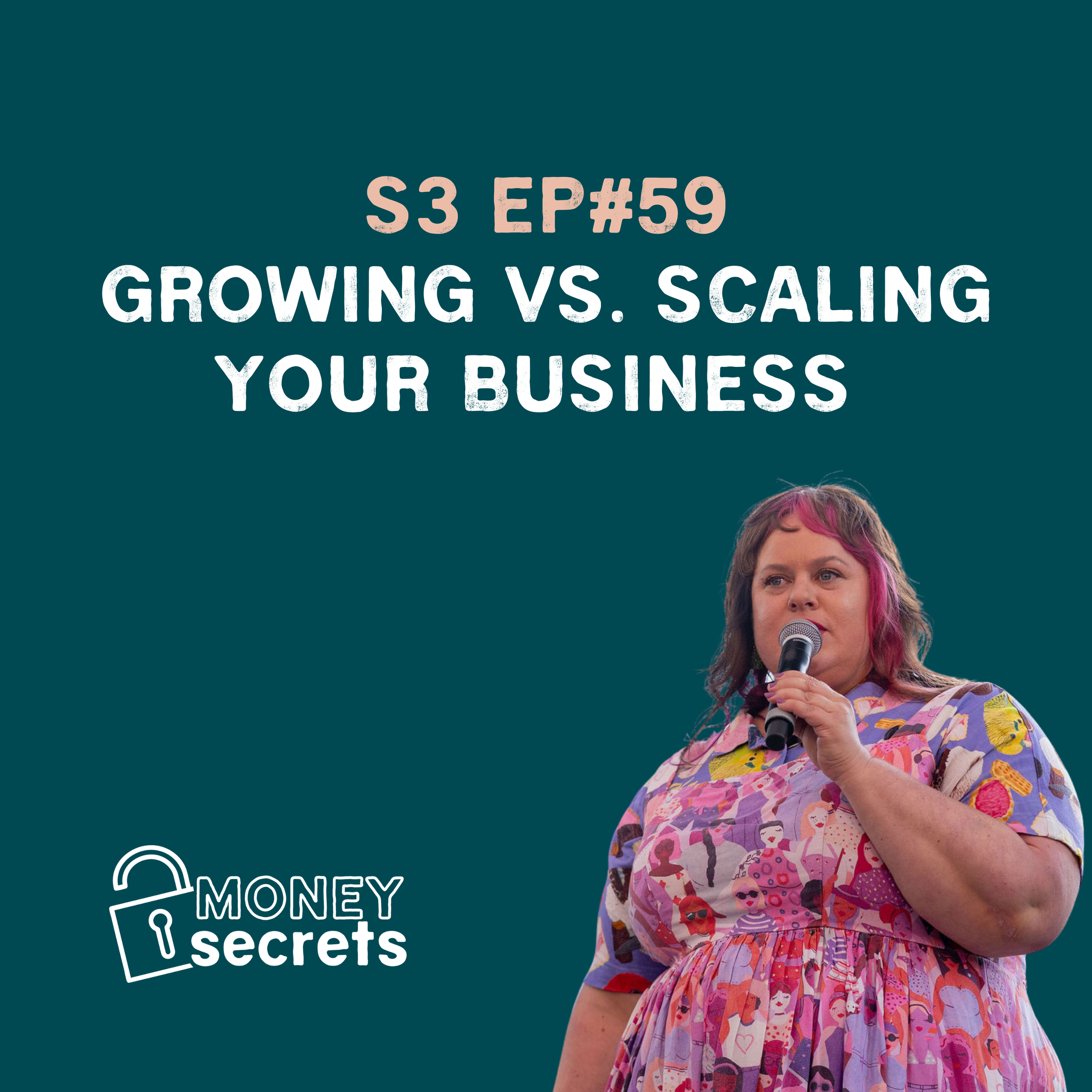
A breakdown of what scaling actually means, why not every business is built to scale, and how growth can be just as powerful — and far more sustainable — when done intentionally. Learn how to make smarter decisions about revenue, profitability, and business structure.
In this episode of Money Secrets, Fi tackles a question that comes up constantly in small business conversations — should you be growing your business, or scaling it?
Listen to Episode 59
What You’ll Learn in This Episode
The real difference between growing and scaling a business
Why these concepts aren’t interchangeable — and why it matters which one you’re pursuing.What “scaling” actually means in practice
How scalable businesses increase income without increasing costs, and why this usually applies to tech, digital products, and one-to-many offers.Why most service businesses grow (not scale)
And why that’s not a failure — it’s simply a different financial model.The myth of passive income
Why all income requires effort somewhere, and where the work actually sits in scalable businesses.How growth impacts cash flow and expenses
Why growing revenue often means growing costs — and how poor expense control can sink otherwise healthy businesses.Why agencies and service providers struggle to “scale”
And how chasing scalability can create unrealistic profit expectations.How to add leveraged income inside a service business
Including group programs, digital products, licensing IP, referrals, and affiliate revenue.What profit margins really look like
The difference between typical growth-based margins (10–25%) and scalable business margins (50%+).How to choose the right strategy for your business
Based on your goals, values, capacity, and desired lifestyle — not internet hype.
Scaling vs. Growing Your Business (EP#59)
Money Secrets Podcast – Episode 59
Introduction
We've made a lot of progress as a society in many areas, but one thing that hasn’t changed enough is our relationship with money. If we want to tip the scales in favour of marginalised people, we need to understand the secrets to making money in small business.
The more we talk about money — especially the secrets that usually stay behind closed doors or on the golf course — the more empowered we become. My mission is to get more money into the hands of good people, specifically business owners like you.
Because I believe small business can change the world. And to do that, we need to be making more money.
Acknowledgement of Country
This episode was recorded on the lands of the Wurundjeri People of the Kulin Nation. I’d like to acknowledge them as the Traditional Owners and custodians of this land and water that I live, work and play on.
I pay my respects to Elders past and present, and recognise that sovereignty has never been ceded. This always was, and always will be, Aboriginal and Torres Strait Islander land.
What Does It Actually Mean to Scale a Business?
Scaling a business means increasing income without increasing costs at the same rate. In a truly scalable model, revenue is not capped by time, space, or human resources — and once the initial work is done, each additional sale costs very little to deliver.
Examples of scalable income include:
Online courses and digital downloads
Software or technology platforms
Subscription-based products
While these models are often described as “passive,” Fi challenges that idea. The reality is that scalable businesses usually require significant upfront investment — in product development, systems, and audience-building — long before they become profitable.
Once that groundwork is in place, income can grow rapidly without a matching increase in expenses, leading to much higher profit margins.
What Growth Looks Like in Most Small Businesses
Growth, on the other hand, is when income increases and costs increase too. This is the most common reality for service-based businesses such as:
Agencies
Consultants
Accountants
Creatives
Health and professional services
In these models, every dollar earned has a cost attached — usually time, wages, or delivery expenses. Growth can still be profitable, but margins tend to be lower and more stable, often sitting between 10–25%.
Fi explains that growth isn’t inferior to scaling — it’s simply a different financial structure. Problems arise when business owners expect growth-based businesses to perform like scalable ones.
Why Chasing Scale Can Hurt Service Businesses
Many service providers feel pressure to “scale” because it’s seen as the marker of success. But trying to force a service business into a scalable model can create:
Unrealistic profit expectations
Cash flow stress
Over-investment in expenses
Burnout and poor delivery
Fi highlights that overspending during growth phases — especially before income is stable — is one of the biggest contributors to business failure.
Understanding whether your business is designed to grow or scale helps you make smarter decisions about pricing, hiring, and investment.
Adding Leveraged Income to a Growth-Based Business
While most service businesses can’t scale in the traditional sense, Fi explains that they can introduce leveraged revenue streams to improve profitability.
These might include:
Group programs or memberships
Digital products or resources
Licensing intellectual property
Affiliate or referral income
These income streams reduce reliance on time-for-money work and allow profit margins to increase — without abandoning a service-based model entirely.
Why Cash Flow Matters More Than Revenue
Fi also unpacks a critical distinction many business owners miss: being profitable doesn’t always mean having healthy cash flow.
Because expenses often need to be paid before income is received, businesses can find themselves profitable on paper but struggling day-to-day. Understanding your growth model helps you anticipate these gaps and manage them intentionally.
Good Money Club
Are you a female or LGBTQIA+ business owner who wants to make more money and create meaningful change? My 6-month program, Good Money Club, is designed to help you do exactly that.
We work on your pricing, positioning, business model, and mindset — so you can build your bank account and your impact. Read more about Good Money Club.
Final Thoughts
Growing and scaling are not better or worse than each other — they’re simply different.
When you understand which model your business operates in, you can:
Set realistic profit expectations
Invest money more wisely
Reduce financial stress
Build a business that aligns with your values and capacity
This episode is a reminder that success isn’t about following trends — it’s about choosing strategies that genuinely support your business and your life.
Outro
Thank you for listening to Money Secrets. If you loved this episode, please subscribe, share it with a friend, or leave a review. Your support helps us get these conversations into the hands of more good people who deserve to thrive in business.
We’ve come so far as a society in many ways, but money is one of the areas where progress hasn’t been enough. If we want to tip the scales in favour of marginalised people, it starts with understanding the secret: money in small business.
In this podcast, Money Secrets, host Fiona (Fi) Johnston—Chartered Accountant, small business advocate, and impact enthusiast—dives into the conversations we need to have about money. The secrets that once stayed behind closed doors (or on the golf course) are finally out in the open.
Fi’s mission? To get more money into the hands of good people, like you. She believes small businesses have the power to change the world, and the key to making a bigger impact is to make—and manage—more money.
________________________________________________________________________
Thank you to everyone involved for bringing this podcast together. We are excited to hear from you with any questions, feedback or suggestions for future episodes that you might have. Send a Direct Message to @peach.business
If you are excited for what’s to come, please like this episode, follow the podcast and share it with your friends. We are thrilled you're here.
Want to find out more about Good Money Club? It's for female and non-binary business owners ready to make more money and impact. Join us?
Check out my FREE Pricing Training you need to set your prices for profitability.
________________________________________________________________________
This podcast episode was recorded on the lands of the Wurundjeri People of the Kulin Nation and I'd like to acknowledge them as the Traditional Owners and custodians of this land and water that I live, work and play on. I'd like to pay respect to elders both past and present, and note that sovereignty has never been ceded. This always was and always will be Aboriginal and Torres Strait Islander land.

Enjoyed this episode?
Subscribe to Money Secrets on your favourite platform so you never miss an insight:
If this episode helped you shift your thinking, I’d love it if you left a review — it helps more small business owners discover the show, and I read every single one.
Have questions or ideas for future episodes? Send me a DM over at @peach.business on Instagram. I’d love to hear from you.
Ready to take this work further?
Join the Good Money Club — my 6-month experience for business owners ready to earn more and make a bigger impact.