How to Make Money from Social Media - with Jarrah Brailey (EP#54)
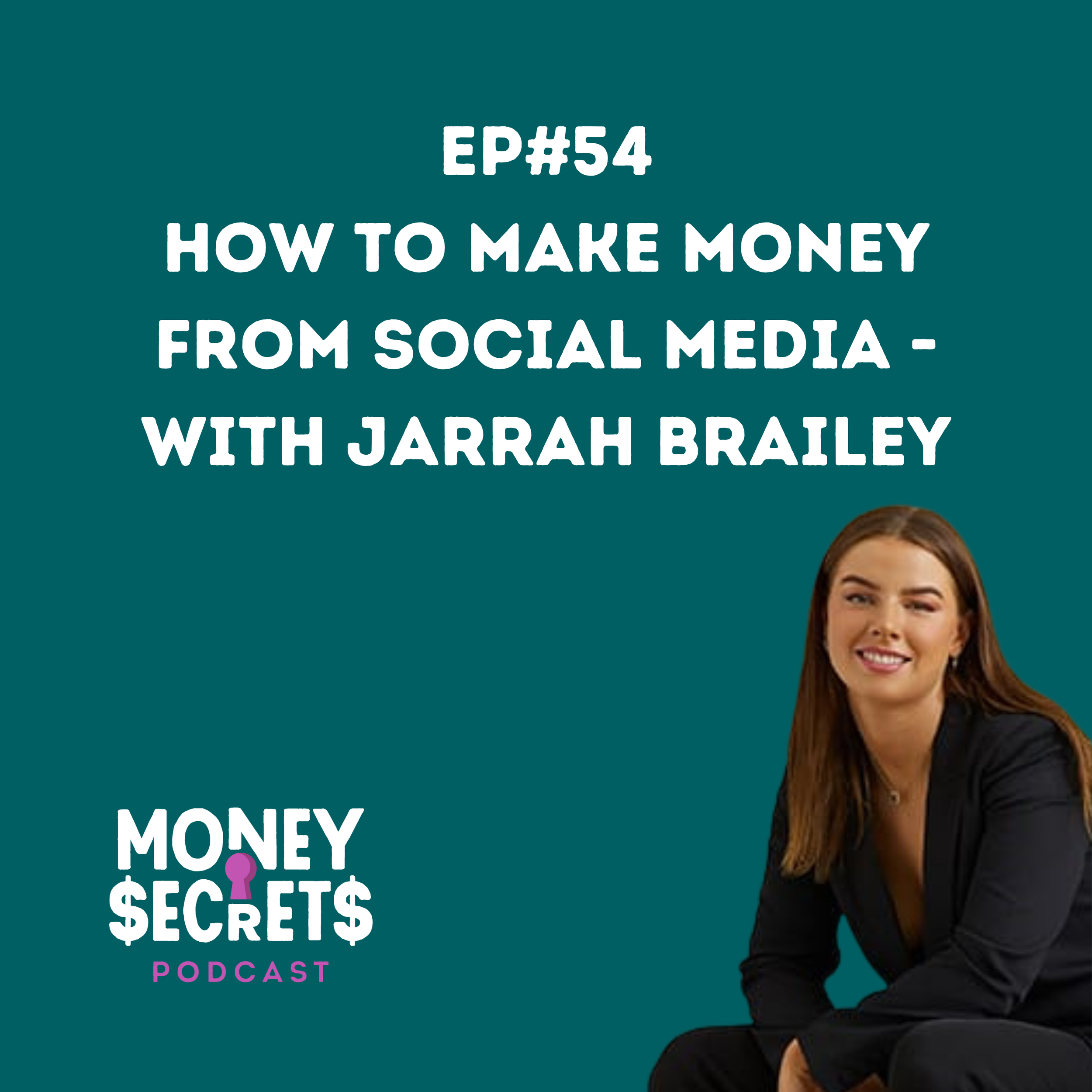
From $10 a day to agency CEO: Jarrah Brailey on content, confidence & charging more. Jarrah shares what really moves the needle on platforms like Instagram and TikTok – and why your creative is your most important currency.
In this episode of Money Secrets, Fi sits down with social media-obsessed agency founder Jarrah Brailey from Jampacked Agency for a behind-the-scenes look at how content, strategy and clever engagement build online communities that make strong businesses.
Listen to Episode 54
What You’ll Learn in This Episode
Why “one size fits all” content is costing you time and money. How copying the same post across Instagram, TikTok, LinkedIn and Pinterest signals you “don’t get” the platform.
Platform culture 101: TikTok vs Instagram. The key differences in pace, polish and “native” feel between TikTok and Instagram, and why branding-heavy carousels don’t fly everywhere.
Organic social as brand builder, not an instant ATM. How to think about organic content as top-of-funnel brand building, and which metrics actually matter (hint: it’s not just sales).
Paid ads as a multiplier, not a magic tap. Why ads can’t fix a leaky offer, clunky website or unclear messaging, and what foundations to have in place before you start spending.
Creative is currency in paid ads. Why the quality, concept and “scroll-stopping” power of your creative now matters more than ever.
Making social media actually sell. Where organic, paid and email each sit in helping people move from curious to converted.
Becoming the kind of business owner who can read their numbers. Jarrah’s journey from crying in a meeting with her accountant to confidently logging into Xero, reading her Profit & Loss and making decisions without waiting for permission.
Pricing as the unlock for better work and better clients. What happened when Jam Packed’s retainers increased, and why higher prices often mean better results, not just more revenue.
Dropping the ego and embracing beginner energy. How allowing yourself to be “the three-year-old on a skateboard” with money and metrics can transform your business faster than pretending you already know it all.
How to Make Money from Social Media - with Jarrah Brailey
Money Secrets Podcast – Episode 54
Introduction
We've made a lot of progress as a society in many areas, but one thing that hasn’t changed enough is our relationship with money. If we want to tip the scales in favour of marginalised people, we need to understand the secrets to making money in small business.
The more we talk about money — especially the secrets that usually stay behind closed doors or on the golf course — the more empowered we become. My mission is to get more money into the hands of good people, specifically business owners like you.
Because I believe small business can change the world. And to do that, we need to be making more money.
Acknowledgement of Country
This episode was recorded on the lands of the Wurundjeri People of the Kulin Nation. I’d like to acknowledge them as the Traditional Owners and custodians of this land and water that I live, work and play on.
I pay my respects to Elders past and present, and recognise that sovereignty has never been ceded. This always was, and always will be, Aboriginal and Torres Strait Islander land.
From Secret Facebook Account to Content House Agency - meet Jarrah Brailey
Jarrah’s relationship with social media started young.
At 10 years old she secretly made her first Facebook account behind her parents’ backs and became that friend everyone went to for, “Which photo should I post?” or “What should I caption this?” Long before “content creator” was a thing, she was already doing the job.
After school, while saving to travel, she took a job with a local glamping business in the Blue Mountains. The owner noticed how much she loved social and offered her $10 a day to run their accounts. It was the early, easier days of Instagram – and Jarrah grew the page quickly.
Other businesses started reaching out asking for her “services,” so she did what many of us have done:
Put up a simple Squarespace website
Called herself a social media marketer
And within six months, at 19, she was full-time freelance
She wasn’t earning a huge amount (“about $700 a week”), but it was more than she’d ever made and felt enormous at the time. Within another six months she hired her first team member and eventually rebranded to Jam Packed Agency – moving from solo freelancer to a fully remote, multi-person agency working with product-based brands around Australia.
Today, Jam Packed is part content house, part paid-ads engine. They shoot, edit and schedule content, manage organic social, and run paid campaigns across Meta, Google, TikTok, Pinterest and more.
And the through-line in all of it?
Content first. Strategy always.
Organic Social: Brand-Building, Not a Cash Machine
One of the biggest mindset shifts from this episode is how Jarrah thinks about organic social media.
Most business owners want to treat their organic content like a direct sales channel:
“If this reel doesn’t make sales, it’s not working.”
Jarrah’s take is different:
Organic social is top-of-funnel.
It’s for brand building, community building, and awareness – not necessarily immediate conversions.Yes, people can buy from a post – and it’s lovely when they do –
but that’s the exception, not the primary KPI.
Instead of asking, “How many sales did this post make?”, she looks at:
Are we growing a community that actually cares?
Are people saving, sharing, replying, DMing, clicking through?
Is there steady website traffic flowing in from social?
Are those people joining the email list, where sales are easier to track and nurture?
In short:
Organic social makes it easier to make money later.
It keeps you in front of your people, builds trust, shows your personality, and gives you a chance to repeat the important stories:
who you are, what you do, why it matters, and how people can work with you.
Platform Culture: One Size Does Not Fit All
Another big theme: you cannot treat every platform the same.
Jarrah sees a lot of brands making this mistake:
They create one “hero” piece of content and shove it everywhere – TikTok, Instagram, Pinterest, LinkedIn, YouTube – with minimal tweaks and hope it works.
Her view?
“Every platform has its own culture, language, jokes, and expectations. If you don’t respect that, people can feel you don’t get it.”
A few examples she gave:
Instagram
– Branded carousels, polished visuals, and more “considered” content can perform well.
– You’re often speaking to people who already follow you; it’s more mid-funnel.TikTok
– Native text, in-app features, scrappy stories, filmed-in-the-car energy.
– People scroll faster, attention spans are shorter, and branding matters less than hook + story.Same video, wrong culture = scroll.
What works beautifully as a branded carousel on Instagram can flop completely on TikTok.
If you don’t have the time or desire to be “chronically online” and immersed in platform culture, Jarrah’s advice is blunt and kind:
either hire someone who is, or narrow your focus to one or two platforms you actually understand.
Paid Ads: Amplifier, Not Emergency Button
We also talked about the common “I’ll just run ads” fantasy.
Jarrah and I both see a version of this all the time:
“My business isn’t working, so I’ll turn on paid ads and that will fix it.”
Her take:
“Paid ads are a multiplier of whatever is already happening in your business.”
If:
Your website doesn’t convert
Your offer isn’t clear
Your cart abandonment is sky-high
Your organic content is flat
…then putting ad spend behind that doesn’t fix it – it amplifies the problems. You’ll just burn money faster.
When can paid ads work beautifully?
When your website is clear and already converting
When your product or service is selling organically
When you know who you’re speaking to and what they care about
When organic social is already doing some heavy lifting
Then ads become water on the garden, not a fire hose into a leaky bucket.
Jarrah sometimes uses ads earlier in the journey purely for data and list-building – for example, using paid campaigns to grow an email list with a strong lead magnet, then converting via email over weeks or months. But that still requires strategy, realistic expectations, and good infrastructure.
“Creative Is Your Currency”
One of my favourite lines from Jarrah in this episode:
“Your creative is your currency.”
Five years ago, you could throw up almost anything in Ads Manager and get a decent return. Those days are gone.
Now:
You’re competing not just with your direct competitors, but with every brand paying to reach that same person.
The only thing that cuts through is strong creative: concept, hook, story, visuals, edit, and platform fit.
At Jam Packed, they won’t take on a client for paid ads unless:
The client invests in high-quality creative (either in-house or through them), and
There’s a tight feedback loop between performance and new creativity.
They might see one video performing really well, then immediately brief and shoot three more variants with different hooks or angles to build on that momentum. If content is made by disconnected teams, that feedback loop stretches out by weeks or months – and the opportunity passes.
Good Money Club
Are you a female or LGBTQIA+ business owner who wants to make more money and create meaningful change? My 6-month program, Good Money Club, is designed to help you do exactly that.
We work on your pricing, positioning, business model, and mindset — so you can build your bank account and your impact. Read more about Good Money Club.
Learning to Love the Numbers (Even If They Scare You)
On the money side, Jarrah is beautifully honest:
She started out with no financial literacy.
She didn’t know what GST was when she registered for it.
Early on, her strategy was basically “Someone will tell me if I’m doing it wrong.”
She assumed:
her accountant would “handle it”
tax would somehow sort itself out
and if there was a problem, someone would tap her on the shoulder.
Spoiler: that’s not how it works.
Over time, she realised that if she wanted to grow a real, sustainable business, she had to become the financial adult in the room. That’s where our work together came in – building:
financial literacy from the ground up
a simple forecasting spreadsheet she now uses confidently
clarity on profit, tax, hiring capacity, and runway
She describes the turning point like this:
“Now I’m at a point where I can make decisions on my own and really back myself in those decisions. I can log into the spreadsheet we built together and change things myself… that felt so unreachable a few years ago.”
We also talked about pricing as a key lever:
She went from charging tiny retainers and hourly rates
to charging premium retainers that reflect the true effort, skill and resources required
which allowed her to slow down, focus on quality, and give her clients dramatically better work
Higher prices didn’t just make her more money. They:
attracted more aligned, values-fit clients
allowed more spacious, thoughtful work
gave her the capacity to reign in chaos and deliver the standard she actually wanted to stand behind
Final Thoughts: Beginner Mindset, Always
Underneath all the strategy and stories, there was a quiet theme running through this episode:
Being willing to be a beginner – again and again.
Jarrah had to be a beginner at:
running a business
learning each new platform
understanding money, tax, profit, and cash flow
pricing in a way that actually sustains her and her team
She talks about dropping the ego and being okay with saying,
“I don’t know what this means, but I’m going to learn.”
That willingness – to ask questions, to admit confusion, to try again – is one of the most powerful money-making skills you can build.
Outro
Thank you for listening to Money Secrets. If you loved this episode, please subscribe, share it with a friend, or leave a review. Your support helps us get these conversations into the hands of more good people who deserve to thrive in business.
We’ve come so far as a society in many ways, but money is one of the areas where progress hasn’t been enough. If we want to tip the scales in favour of marginalised people, it starts with understanding the secret: money in small business.
In this podcast, Money Secrets, host Fiona (Fi) Johnston—Chartered Accountant, small business advocate, and impact enthusiast—dives into the conversations we need to have about money. The secrets that once stayed behind closed doors (or on the golf course) are finally out in the open.
Fi’s mission? To get more money into the hands of good people, like you. She believes small businesses have the power to change the world, and the key to making a bigger impact is to make—and manage—more money.
________________________________________________________________________
Thank you to everyone involved for bringing this podcast together. We are excited to hear from you with any questions, feedback or suggestions for future episodes that you might have. Send a Direct Message to @peach.business
If you are excited for what’s to come, please like this episode, follow the podcast and share it with your friends. We are thrilled you're here.
Want to find out more about Good Money Club? It's for female and non-binary business owners ready to make more money and impact. Join us?
Check out my FREE Pricing Training you need to set your prices for profitability.
________________________________________________________________________
This podcast episode was recorded on the lands of the Wurundjeri People of the Kulin Nation and I'd like to acknowledge them as the Traditional Owners and custodians of this land and water that I live, work and play on. I'd like to pay respect to elders both past and present, and note that sovereignty has never been ceded. This always was and always will be Aboriginal and Torres Strait Islander land.
Enjoyed this episode?
Subscribe to Money Secrets on your favourite platform so you never miss an insight:
If this episode helped you shift your thinking, I’d love it if you left a review — it helps more small business owners discover the show, and I read every single one.
Have questions or ideas for future episodes? Send me a DM over at @peach.business on Instagram. I’d love to hear from you.
Ready to take this work further?
Join the Good Money Club — my 6-month experience for business owners ready to earn more and make a bigger impact.